
MENU
Oil on canvas; signed on lower right: ‘G. A Sartorio Fregene MCMXXVI’’; on the back: Galleria Pesaro label
160 x 133 cm
Oil on canvas; signed on lower right: ‘G. A Sartorio Fregene MCMXXVI’’; on the back: Galleria Pesaro label
160 x 133 cm
EXHIBITED
Mostra personale di Giulio Aristide Sartorio, La Galleria Pesaro, Milan, 1929, n. 36.
Giulio Aristide Sartorio was among the most significant Italian artists active between the 19th and 20th centuries. Associated with Symbolism and the Roman Pre-Raphaelite milieu, he contributed decisively to the development of modern Italian public decoration, most notably through the monumental frieze painted between 1908 and 1912 for the Italian Parliament in Palazzo Montecitorio, Rome. His wide-ranging production spans landscape, animalier painting, travel subjects, and war reportage, reflecting an artistic career shaped by international experiences. In 1915 he enlisted voluntarily in the First World War, where he was wounded and taken prisoner, an experience that profoundly marked his later artistic sensibility.
Painted in 1926 and exhibited at Sartorio’s 1929 solo exhibition in Milan, Madonna belongs to the artist’s late Fregene cycle. Developed after the war and in the context of a renewed private life, this group of works centres on domestic intimacy and the luminous coastal landscape of Fregene, expressed through light, delicate tonal harmonies, and an atmosphere of contemplative calm. This naturalistic-elegiac sensibility may reflect Sartorio’s engagement with the work of Joaquín Sorolla (1863–1923), regularly present at the Venice Biennale from 1895 (like Sartorio) until 1926.
Within this context, Madonna encapsulates the poetic essence of the cycle. The graceful depiction of Marga Sevilla — Sartorio’s wife and an actress who collaborated with him in early film experiments — holding her young son transforms a private maternal moment into an image of symbolic resonance, evoking Dante Alighieri’s spiritualised femininity also admired by Pre-Raphaelite painters. The painting’s grand scale, refined luminosity and vertical composition exemplify Sartorio’s late style, in which family affection, mythic suggestion, and everyday beauty converge in a vision of serene renewal.
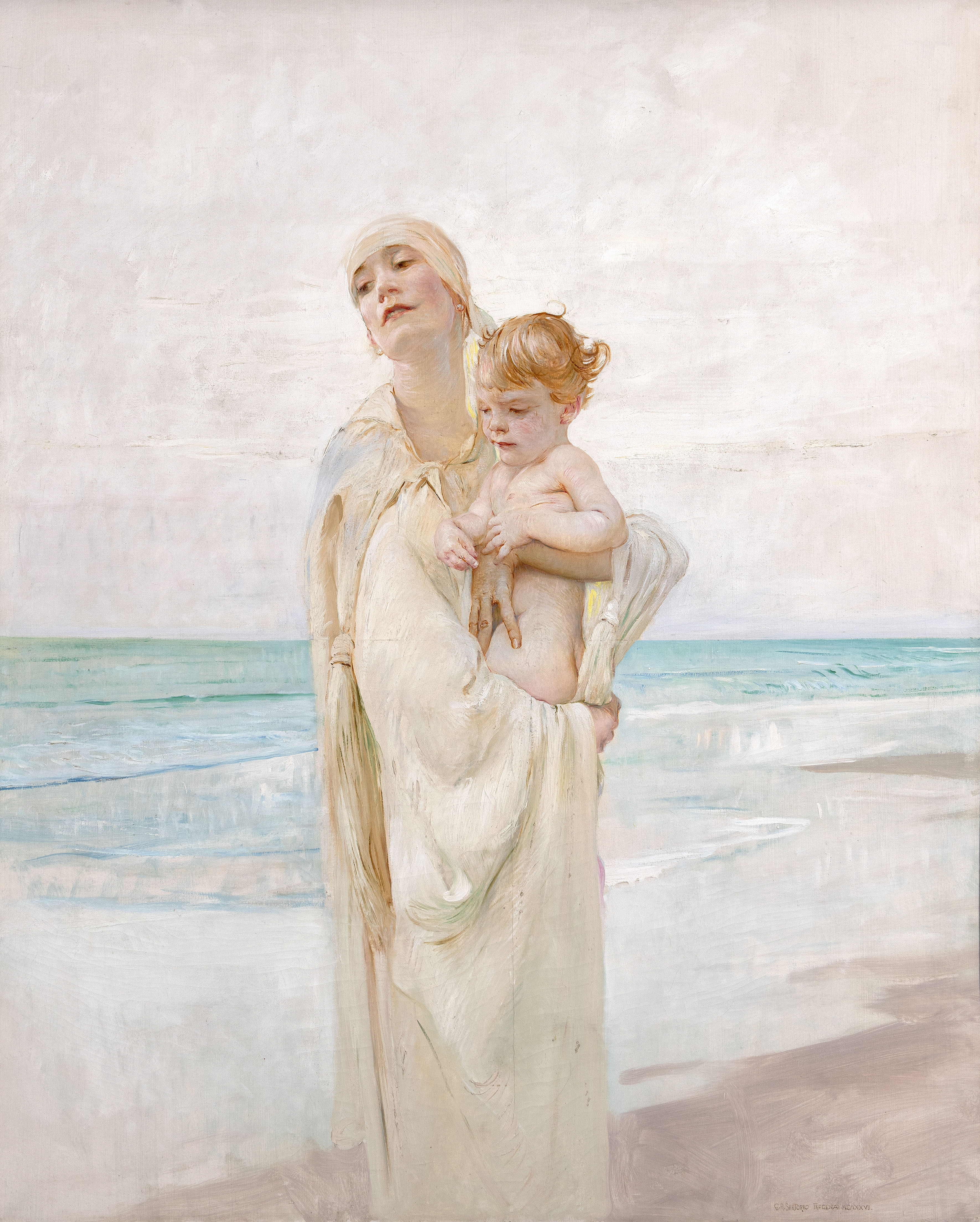
Oil on canvas; signed on lower right: ‘G. A Sartorio Fregene MCMXXVI’’; on the back: Galleria Pesaro label
160 x 133 cm
Oil on canvas; signed on lower right: ‘G. A Sartorio Fregene MCMXXVI’’; on the back: Galleria Pesaro label
160 x 133 cm
EXHIBITED
Mostra personale di Giulio Aristide Sartorio, La Galleria Pesaro, Milan, 1929, n. 36.
Giulio Aristide Sartorio was among the most significant Italian artists active between the 19th and 20th centuries. Associated with Symbolism and the Roman Pre-Raphaelite milieu, he contributed decisively to the development of modern Italian public decoration, most notably through the monumental frieze painted between 1908 and 1912 for the Italian Parliament in Palazzo Montecitorio, Rome. His wide-ranging production spans landscape, animalier painting, travel subjects, and war reportage, reflecting an artistic career shaped by international experiences. In 1915 he enlisted voluntarily in the First World War, where he was wounded and taken prisoner, an experience that profoundly marked his later artistic sensibility.
Painted in 1926 and exhibited at Sartorio’s 1929 solo exhibition in Milan, Madonna belongs to the artist’s late Fregene cycle. Developed after the war and in the context of a renewed private life, this group of works centres on domestic intimacy and the luminous coastal landscape of Fregene, expressed through light, delicate tonal harmonies, and an atmosphere of contemplative calm. This naturalistic-elegiac sensibility may reflect Sartorio’s engagement with the work of Joaquín Sorolla (1863–1923), regularly present at the Venice Biennale from 1895 (like Sartorio) until 1926.
Within this context, Madonna encapsulates the poetic essence of the cycle. The graceful depiction of Marga Sevilla — Sartorio’s wife and an actress who collaborated with him in early film experiments — holding her young son transforms a private maternal moment into an image of symbolic resonance, evoking Dante Alighieri’s spiritualised femininity also admired by Pre-Raphaelite painters. The painting’s grand scale, refined luminosity and vertical composition exemplify Sartorio’s late style, in which family affection, mythic suggestion, and everyday beauty converge in a vision of serene renewal.