
MENU
Oil on copper
49 × 40 cm
PROVENANCE:
Private collection, Switzerland;
Until sold Sotheby’s, London, 3 July 1996, lot 44 (as attributed to Artemisia Gentileschi);
The Walpole Gallery, London;
Private collection, London.
EXHIBITED
Phoenix, Phoenix Arts Museum, Copper as Canvas: Two Centuries of Masterpiece Paintings on Copper, 1575–1775, 19 Dec. 1998 – 28 Feb. 1999;
Kansas City, Nelson-Atkins Museum of Art, Copper as Canvas: Two Centuries of Masterpiece Paintings on Copper, 1575–1775, 28 Mar. – 13 Jun. 1999;
The Hague, Koninklijk Kabinet van Schilderijen, 26 Jun. – 22 Aug. 1999), New York, 1999, no. 21 (as “Orazio Gentileschi”)
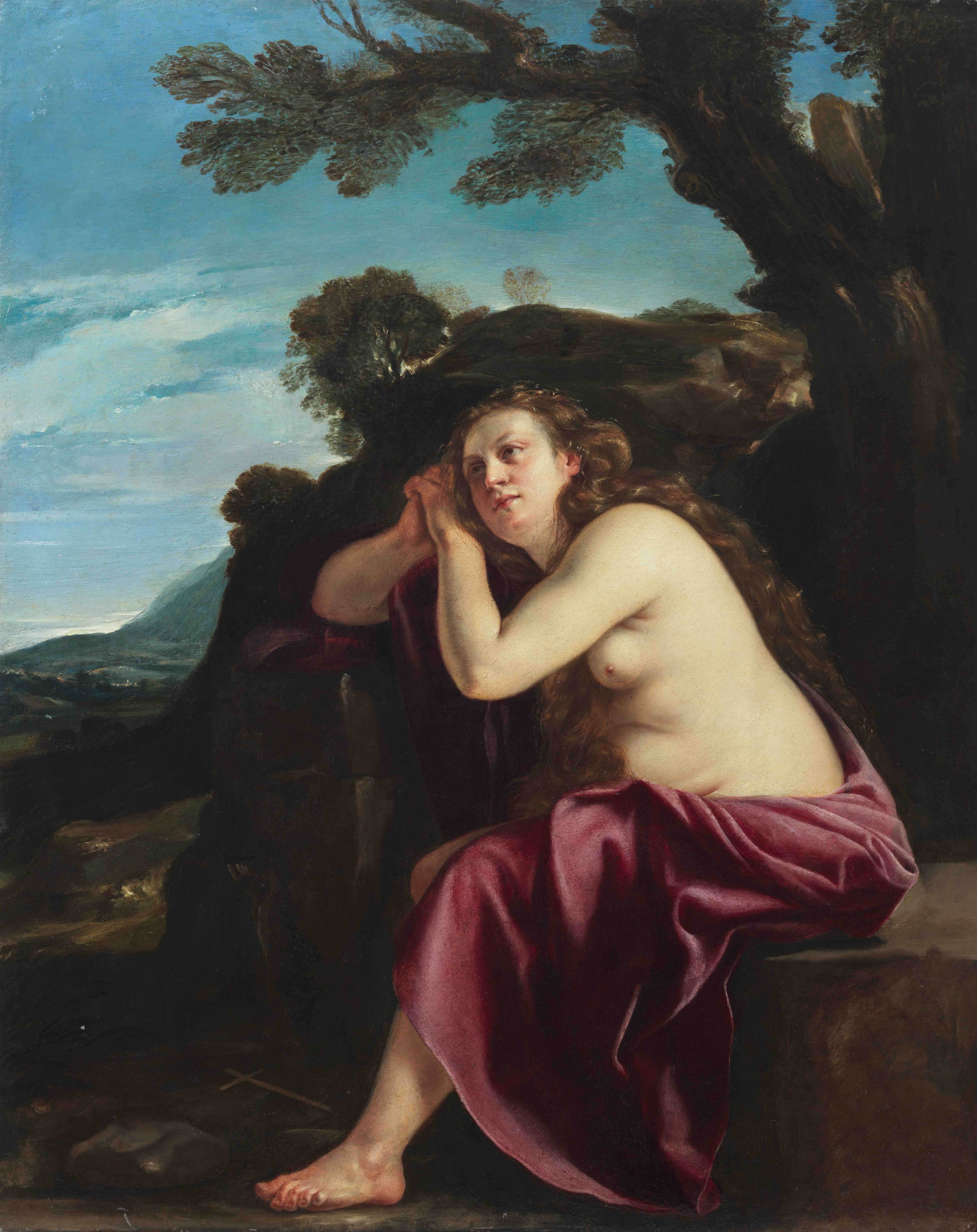
The reappearance of this copper, after more than thirty years in a private collection and largely unseen by scholars, allows us to recognise the exceptional quality of one of Artemisia Gentileschi’s masterpieces. The Penitent Magdalene, executed with remarkable refinement, demonstrates the artist at the height of her powers. Working on copper—a rare but significant support in her production—Artemisia exploits its smooth, luminous surface to achieve subtle gradations of flesh tones, resulting in a work of striking intimacy and technical assurance.
The painting first resurfaced in 1996, when it was attributed to Artemisia, before being reassigned to Orazio by R. Ward Bissell, at a time when Artemisia was still often regarded as a more modest follower of her father. In the 2001 Orazio and Artemisia Gentileschi exhibition catalogue the attribution was already reopened between father and daughter, based on a black-and-white photo. In the decades since, the substantial expansion of scholarship on Artemisia has clarified the painting’s position within her corpus. The attribution of the copper has recently found broad consensus among Artemisia scholars and is supported by independent studies by Maria Cristina Terzaghi and Giuseppe Porzio.
On stylistic grounds, the Magdalene can be securely dated to the early 1620s, shortly after Artemisia’s return to Rome from Florence. Close comparisons may be drawn with the Susanna and the Elders at Burghley House (signed and dated 1622), particularly in the conception of the female figure and the nuanced treatment of flesh. The naturalistic modelling and tactile rendering of the body distinguish Artemisia’s approach from that of Orazio, while the landscape background reflects the Roman artistic milieu of the period, notably recalling Guercino, who at precisely this time shared the patronage of the Ludovisi family with Artemisia.
Oil on copper
49 × 40 cm
PROVENANCE:
Private collection, Switzerland;
Until sold Sotheby’s, London, 3 July 1996, lot 44 (as attributed to Artemisia Gentileschi);
The Walpole Gallery, London;
Private collection, London.
EXHIBITED
Phoenix, Phoenix Arts Museum, Copper as Canvas: Two Centuries of Masterpiece Paintings on Copper, 1575–1775, 19 Dec. 1998 – 28 Feb. 1999;
Kansas City, Nelson-Atkins Museum of Art, Copper as Canvas: Two Centuries of Masterpiece Paintings on Copper, 1575–1775, 28 Mar. – 13 Jun. 1999;
The Hague, Koninklijk Kabinet van Schilderijen, 26 Jun. – 22 Aug. 1999), New York, 1999, no. 21 (as “Orazio Gentileschi”)
The reappearance of this copper, after more than thirty years in a private collection and largely unseen by scholars, allows us to recognise the exceptional quality of one of Artemisia Gentileschi’s masterpieces. The Penitent Magdalene, executed with remarkable refinement, demonstrates the artist at the height of her powers. Working on copper—a rare but significant support in her production—Artemisia exploits its smooth, luminous surface to achieve subtle gradations of flesh tones, resulting in a work of striking intimacy and technical assurance.
The painting first resurfaced in 1996, when it was attributed to Artemisia, before being reassigned to Orazio by R. Ward Bissell, at a time when Artemisia was still often regarded as a more modest follower of her father. In the 2001 Orazio and Artemisia Gentileschi exhibition catalogue the attribution was already reopened between father and daughter, based on a black-and-white photo. In the decades since, the substantial expansion of scholarship on Artemisia has clarified the painting’s position within her corpus. The attribution of the copper has recently found broad consensus among Artemisia scholars and is supported by independent studies by Maria Cristina Terzaghi and Giuseppe Porzio.
On stylistic grounds, the Magdalene can be securely dated to the early 1620s, shortly after Artemisia’s return to Rome from Florence. Close comparisons may be drawn with the Susanna and the Elders at Burghley House (signed and dated 1622), particularly in the conception of the female figure and the nuanced treatment of flesh. The naturalistic modelling and tactile rendering of the body distinguish Artemisia’s approach from that of Orazio, while the landscape background reflects the Roman artistic milieu of the period, notably recalling Guercino, who at precisely this time shared the patronage of the Ludovisi family with Artemisia.