
MENU
Oil on canvas
68 × 61 cm
PROVENANCE
Lempertz, Old Masters & 19th Century, Part I, 16 November 2024, lot 2057 (as Gregorius de Coninck);
Where acquired.
Recently discovered and long obscured beneath discoloured varnish, this refined still life was formerly attributed to Gregorius de Coninck (1633–1680). Following careful study, Dr Fred G. Meijer has convincingly re-established the painting as an early work by Jan Weenix, datable to the second half of the 1670s.
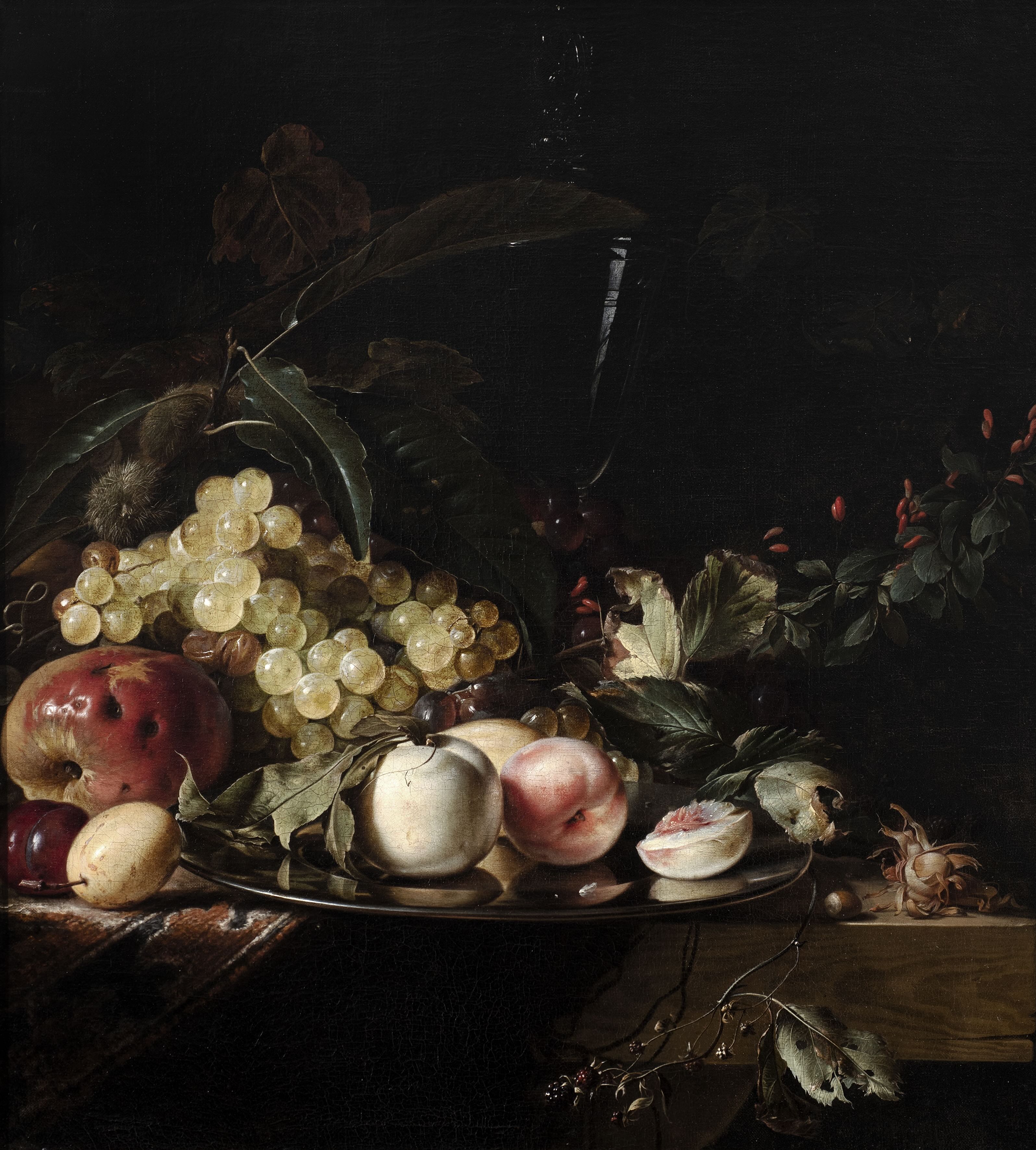
The composition arranges grapes, peaches, plums and apples upon a draped table beside a silver plate and a lidded glass goblet, set against a deep, shadowed ground. Delicate gradations of light animate the translucent grapes and softly modelled peaches, while the subtly blemished apple—an expressive and characteristic motif—reveals the artist’s keen sensitivity to naturalistic detail during this phase.
Trained by his father Jan Baptist Weenix and admitted to the Utrecht painters’ guild in 1664, Weenix settled in Amsterdam in the early 1670s, where he turned to still life before later achieving renown for his grand game pieces. The present work belongs to a coherent group of early paintings distinguished by luminous clarity and supple handling. While rooted in the tradition of Jan Davidsz. de Heem (1606–1684), Willem van Aelst (1627–after 1683), and Abraham Mignon (1640–1679), this canvas conveys a distinct, quietly poetic reflection on the fragility and transience of nature.
Oil on canvas
68 × 61 cm
PROVENANCE
Lempertz, Old Masters & 19th Century, Part I, 16 November 2024, lot 2057 (as Gregorius de Coninck);
Where acquired.
Recently discovered and long obscured beneath discoloured varnish, this refined still life was formerly attributed to Gregorius de Coninck (1633–1680). Following careful study, Dr Fred G. Meijer has convincingly re-established the painting as an early work by Jan Weenix, datable to the second half of the 1670s.
The composition arranges grapes, peaches, plums and apples upon a draped table beside a silver plate and a lidded glass goblet, set against a deep, shadowed ground. Delicate gradations of light animate the translucent grapes and softly modelled peaches, while the subtly blemished apple—an expressive and characteristic motif—reveals the artist’s keen sensitivity to naturalistic detail during this phase.
Trained by his father Jan Baptist Weenix and admitted to the Utrecht painters’ guild in 1664, Weenix settled in Amsterdam in the early 1670s, where he turned to still life before later achieving renown for his grand game pieces. The present work belongs to a coherent group of early paintings distinguished by luminous clarity and supple handling. While rooted in the tradition of Jan Davidsz. de Heem (1606–1684), Willem van Aelst (1627–after 1683), and Abraham Mignon (1640–1679), this canvas conveys a distinct, quietly poetic reflection on the fragility and transience of nature.